Two Easy Ways to Start Earning Rewards!
Become a member today! Members-only pricing and offers, personalized care notifications, Vital Care points back on every purchase and more!
 Become a credit card member today!
Earn 2X Pals Rewards points at Petco
when you use Petco Pay!APPLY NOWLearn More About Petco Pay Benefits
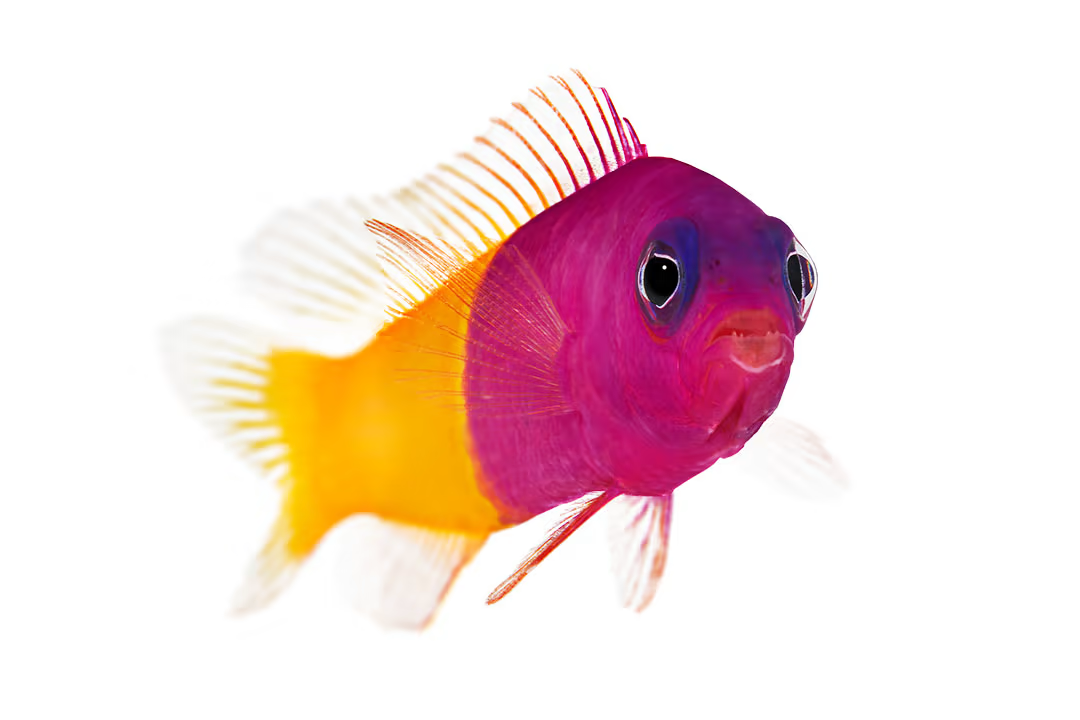
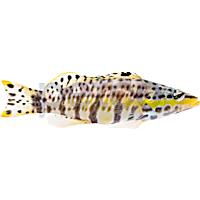
Basslets
Get It Today




Related Articles & Questions
- Care Sheets
Master Small Marine Fish Care: Tank Setup, Food, & Compatibility Guide
Small Marine Fish are favorites with marine aquarists and includes a wide range of species.
Updated on April 9th, 2026
- Care Sheets
Essential Large Marine Fish Care Guide: Tank Setup, Diet, & Tank Mates
Learn how to care for large marine fish, recommended diet and habitat setup. Find the right food, supplies and equipment at your neighborhood Petco.
Updated on April 9th, 2026
- Care Sheets
Ultimate Wrasse Care Guide: Tank Setup, Feeding, & Compatibility
Learn how to care for a wrasse, recommended diet and aquarium setup. Find wrasse for sale, supplies and equipment at your neighborhood Petco.
Updated on April 9th, 2026
- Care Sheets
Build Your Thriving Saltwater Tank: Easy Setup for Marine Life
Learn how to set up a saltwater fish tank and key considerations regarding placement, supplies needed, and the overall set up process.
Updated on October 23rd, 2025
- Care Sheets
Aquatic Pet Safety: Keep Your Home Aquarium Pets Healthy & Safe
Learn how to safely handle your aquatic life to avoid toxin & bacterial exposure. Find aquatic life care supplies at your neighborhood Petco pet care center.
Updated on October 23rd, 2025
- Vet Q & A
What fish can I put in a tank with my Bass that it won't eat?
Thanks for reaching out about Samlarie. Bass are very aggressive feeders with an ability to open their mouths wide, therefore swallowing other smaller fish. Not sure which type of bass you have but in public aquaria, rockfish are often housed with bass, but should be of similar size. Good luck.
Updated on September 24th, 2025
- Vet Q & A
How to sex Australian Bass for breeding and what supplies are needed?
Males are much smaller than females. Males will reach sexual maturity between 3-4 years of age, females won't be ready until they are 5-6 years of age. You can check the vent of the fish. Males will have an oblong opening while the females will be more circular. In the springtime, mature females will become fat with roe (eggs). During this time of year, you can gentle massage the abdomen of an adult fish, if a milky substance comes out then you have a male. This is its sperm. You can follow this link to find information regarding breeding and the necessary supplies. http://www.aquablueseafoods.com.au/bass-breeding.shtml
Updated on September 24th, 2025
- Food & Nutrition
What fish and supplies are best for a beginner's small tank?
Without anything to use for scale, it is hard for me to tell how big your tank is, but in general it seems very small. Also, the water that is in the tank appears very cloudy right now, so that would be the first place to start. Water quality is very important, and will make or break your ability to house and care for fish. I would recommend getting a good filter system (you can visit a local pet store to assist you with brands in your area, as I am not familiar with what you can get in India). Be sure to bring the measurements (height, length, width) of your tank, or the gallons or liters so they can tell you what capacity of filter you will need. Everything else will depend on what types of fish you get - if you plan on getting multiple fish, they will need to be small - a general rule of thumb is one square inch of fish per gallon of water. Depending on the species you get, you may need to also get a bubbler to ensure there is enough oxygen in the water for them, and you will also likely need to get some sort of substrate for the bottom and cage furniture (different species have different air requirements, and some are secretive and like to hide). You may also need a water heater, depending on the species you would like to house. But, depending on how small your tank is, it may be hard to get a water heater that will fit. The food type will also depend on what species you get, as there can be differences in diet type between species. I hope that gives you a place to start, and good luck!
Updated on September 24th, 2025
- Vet Q & A
First fish tank: What Tetras and supplies for my 12-inch tank?
Before you buy any fish, you will need to set up the tank. A basic set up includes: a tank, filter, hood/light, heater, gravel and some decor. The tank should run without fish for at least 4 to 6 weeks. This gives it time to cycle. The Nitrogen Cycle is critical to the health of the tank and any fish you will be keeping. During this time, beneficial bacterial will populate the filter and substrate (gravel). These bacteria will be responsible for breaking down fish wastes and other wastes (uneaten food, dead plants, etc.). You will need a home test kit to monitor water chemistry (ammonia, nitrites, nitrates, pH) or you will have to submit water samples for testing. Most pet stores will do this for free or for a small fee. At first, you will see high levels of ammonia and nitrites. Over time, as bacteria grow, these levels will drop. When ammonia and nitrites are at 0 ppm and nitrates are below 20 ppm, you can consider adding fish. Regular (every 1 or 2 weeks) partial water changes as well as filter changes will be needed to maintain stable water chemistry and adequate water quality. The size of your tank will determine what fish and how many you will be able to keep. Most Tetras do best in groups, so a 12 inch tank may not be large enough. There are several article in the Petco Pet Education Center, formerly Petcoach Library that will provide more detailed information. Click on "Educational Center" at the top of the page, then scroll down to "Articles" and click. Use the Search Bar to find articles regarding aquarium set up and fish keeping.
Updated on September 24th, 2025
- Training & Behavior
My new Glofish are hiding and staying at the bottom. Is this normal?
Thanks for your question about your fish, and congratulations on your new family members! I didn't see how recently the tank was set up, but there are a couple of things that could be going on. I would start by checking your water quality - any abnormalities in water quality can make fish have abnormal behaviors, and the water looks a bit murky in the photos you provided. There may be parameters that need to be addressed depending on what you find. If you do not have a water quality kit, they can be purchased at the pet store or an aquarium store, or you can take a sample of your water in for evaluation to these places as well. Some will charge a small fee for this service, just so you are prepared. Also, with recent tank set ups, it can be stressful for fish as they are in a new habitat. I would recommend keeping the light on for only a few hours per day to start, as the bright lights can be shocking for them (since fish don't have eyelids). Gradually you can increase the length of time that the lights are on so that you reach a cycle of 10-12 hours of light and 12-14 hours of darkness for them. I hope this gives you a place to start, and I wish you and your mom the best with the new pets!
Updated on September 24th, 2025